

Cohousing, Eco-villages and other forms of collaborative living


6 Sept 2010
Sep 12th is Sustainable House Day 2010 & Cohousing Talk
on Sunday Sep 12th is Sustainable House Day 2010 you can have the opportunity to get a real-life look inside houses that have been designed, built or fitted out with sustainability in mind and talk to owners.
While you are in the North-Shore area and would also be interested in hearing about creating a sustainable neighbourhood, join us for cup of tea, something to eat and a cohousing talk
this Sunday 2pm @ Currambena preshool 205 Longueville Rd, Lane Cove
the talk usually last for an hour, and we will stay to answer any in depth questions.
http://www.sustainablehouseday.com/new-south-wales.php
the talk usually last for an hour, and we will stay to answer any in depth questions.
http://www.sustainablehouseday.com/new-south-wales.php
29 Aug 2010
Sociocracy - Dynamic Governance
Awhile ago I came across a new governance tool called Sociocracy, luckily enough I met Lyndall Parris of SCEV- Sydney Coastal Eco Village initiative. Lyndall has been to the cohousing conference in the U.S and in one of our discussions she mentioned her interest in it.
Last Week I've participated in a presentation about Sociocracy given by Lyndall which was very intriguing.
The Consensus decision making tool adopted by most cohousing groups can be at times very long and tiring process. in order to resolve and improve decision making process many groups are searching for various governance models that can help them create a more efficient working system. Recently Sociocracy also known as Dynamic Governance, is being widely explored and adopted as a new form of a decision making tool which helps groups run their meeting in a more efficient manner.
Adopted from the corporate world Sociocracy simplifies the decision making process by adopting a circle structure which is “a semi-Autonomous unit that has its own aim/ role. It makes the policy decisions within its domain; delegates the leading, doing and measuring functions to its own members...” (Villines, S.& Buck, J. 2007, P.75) .

Image at ‘We the People Consenting to a Deeper Democracy’ by (Villines, S.& Buck, J. 2007, p.74)
sociocracy john buck

|

27 Aug 2010
Bright Green: Urban Cohousing for the 21st Century
Great article on future inner city urban cohousing
World changing: Bright Green: Urban Cohousing for the 21st Century
World changing: Bright Green: Urban Cohousing for the 21st Century
22 Aug 2010
Shiloh builds his Cohousing
 Being involved in cohousing is something that the whole family engages with.
Our 3+ year old son is constantly talking about it and recently he wants us to
build cohousing with his cubes . His ideal cohousing occurs in the city in an high rise.
:}
Cheers
GIlo
19 Aug 2010
Blue Mountains Group
New Cohousing Initiative is now starting in the Blue Mountains.
The Beautiful Scenery of the Blue Mountains, affordable
land and a sense of community which already exists
provides a great platform for establishing a Cohousing Community.
For more information contact
Gilo on 0424 490 554
The Beautiful Scenery of the Blue Mountains, affordable
land and a sense of community which already exists
provides a great platform for establishing a Cohousing Community.
For more information contact
Gilo on 0424 490 554
8 Jul 2010


First Common Meal


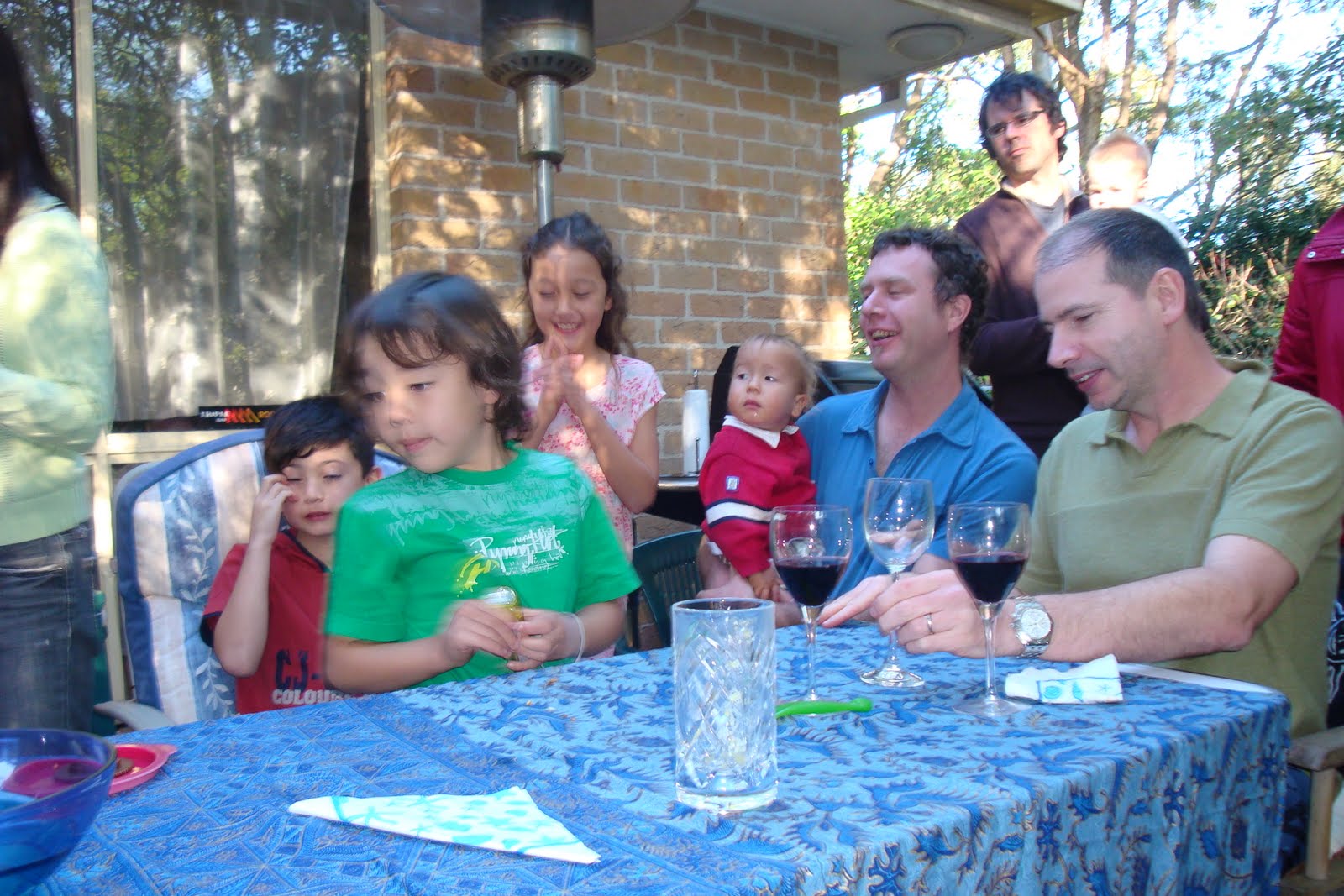
Mikee and Martin were kind enough to invite us all over to their house for a Saturday afternoon barbi, our first Common Meal. As it happened it was also Jamie’s 3..... Birthday, CONGRATULATION.
It was a great Saturday afternoon with great and tasty food wines and beers, finishing with Mikee’s famous baked cheese cake, mmm... Yummy.....

It was great hanging out not talking only about cohousing, it sure gave us some food for thoughts as for how would it be in a community enjoying the delights and having lots of reasons to celebrate.

So many thanks & happy birthday to Jamie and also to Martin and Gilo [born on the same day]
cheers
9 Jun 2010
Open Meeting # 3 - Sunday 27 th June 10.00am
Envisage living in a vibrant community which is environmentally aware, energy efficient. With willing, fun loving, diverse people sharing the many household tasks across the community, creating more free time to live your dreams, and reducing your cost of living! Home grown veggies! ......
so if you are curious and want to know more we are organising an informal talk
@
Currambena preschool, 205 Longueville Road, Lane Cove
Sunday 27th June 10.00am
or please contact us if you have any questions
5 May 2010
Open Meeting #2

Our 2nd open meeting held on Saturday May 1st, attracted new families and professionals, interested in learning about the cohousing model.
We wish to thank them for coming and sharing with us their interests and experiences.

We would also like to thank those of you who expressed an interest and could not make it to the meeting, we will keep you posted.

3 May 2010
Educational Meeting # 1 - Dr. Louise Crabtree
Dr. Louise Crabtree, from the Urban Research Centre @ the University of Western Sydney was the first professional invited to join our educational meeting series, aimed at educating the members of ‘Sydney Cohousing’ in various areas such as housing development, sustainability, legal issues, water and more..
Louise research focuses on the social, ecological and economic sustainability of community-driven housing developments in urban Australia; on the uptake of housing innovation in practice and policy; and, on the interfaces between sustainability, property rights, institutional design and democracy. She is interested in the translation of the community land trust model of land stewardship from the US and UK into an Australian context and in challenges encountered in scaling up or replicating innovation in housing design and delivery
Louise talked to us about the various options for improving affordability of our cohousing project. We discussed different ways of purchasing or acquiring the use of land and possibilities for partnering with other groups. She’ll be assisting us to make more contacts with groups, businesses and individuals that can help us develop our community.
http://www.uws.edu.au/urban_research_centre/urc/key_people/doctor_louise_crabtree2
17 Apr 2010
Cohousing - the Sustainable / Affordable Question

The cohousing literature suggests that European and US cohousing communities have a better quality of life due to a heightened sense of well-being and a more affordable lifestyle (Marcus & Dovey, 1991; Meltzer, 2000; Brenton, 1998; Fromm, 1991).
For Sydney Cohousing, sustainability and affordability are imperative for establishing a successful community. We have had many discussions about the meaning of sustainability and affordability, how far are we willing to go in order to achieve it? Are we willing to drop some important environmentally sustainable feature (principles) in favour of economical or social sustainability for us to build our “dream” homes? And how vital will it be for us to adapt to or change the way we live or at least the way we dwell, to be able to have a better quality of life?
Sustainability is defined as "forms of progress that meet the needs of the present without compromising the ability of future generations to meet their needs."
Let’s look at it this way; putting aside our care for and responsibility to our global environment and focusing on our responsibility to our families or future families. We put a lot of love, energy and money into raising our kids, with hopes that they will become confident, healthy, considerate and happy individuals. In short, have a better future. And yet everything in our current environment does not allow us to provide what we wish to.
Here are only few examples; most of the foods that we buy in local food stores are full of additives, flavours, preservatives and sugar (unless we are able to afford to buy organic products, or grow or make it ourselves); our domestic environment is full of various materials, from carpets to children’s plastic toys to paints which “contain mutagenic materials, heavy metals, dangerous chemicals and dyes“[i], that are constantly emitting hazardous particles that we inhale. All this results in very serious health issues in kids and adults. There goes health...
The modern way of life for city dwellers is becoming more and more difficult. We hear about predictions of a 60% rise in electricity bills in the next 3 years, water rates won’t stay far behind. If we add fuel costs, rents and mortgages, the value of our money decreases, resulting in lower quality of life and our well being. Moreover, it will force us to work more only to maintain our current quality of life, leaving us with less time to spend with the family and much more stress. There goes quality of life...
As for the environment, well it is enough to see where we are today “the amount of resources we use (and buy), the waste we produce and the emissions we produce”[ii], to realise how ridiculously wasteful our consumer society is and the impact it has on the environment. There goes the future of our future generations...
In our discussions we’ve realised that although cohousing in its essence is social sustainability, and for some of the members the social aspect was their reason for joining, without the balance between the environmental & economical aspects as well, our community could not really exist and sustain itself.
Therefore the true meaning of social and affordable does not lay in how cheap we can build our homes, (unless alternative or innovative construction methods are adopted, it will most likely not be cheaper than buying a new house) or designing for social interaction. It lies in the adaptation of [ESD] environmentally sustainable design principles and [SCD] social contact design principles: collecting rain water, storm water, recycling grey water, if conditions allow, growing our own food, sharing transportation and amenities and by creating activities that encourage social interaction rather than imposing them, such as shared meals and more.
All of the above will allow us to significantly reduce our expenses, have more quality family time during the week, improve our social life, while preserving our privacy, increase our quality of life and well being.
The Cohousing model may be a magic bullet as a future housing type. It encourages pro-environmental behaviour; strong social networks; socially inclusivity; increases residents’ well-being; and provides affordable accommodation and lifestyle options. Cohousing also appears to fulfil the objectives and adopt similar design strategies as the New Urbanism movement for housing, which again is thought to produce more sustainable housing models.
Sydney Cohousing are committed to achieving and fulfilling these principals with hopes that inclusion and affordability will not undermine its sustainability credentials.
http://www.griffith.edu.au/ofm/sustainability/content_definition.html
Williams, Jo(2005) 'Sun, surf and sustainable housing—cohousing, the Californian experience', International Planning Studies, 10: 2, p.8]
Subscribe to:
Posts (Atom)